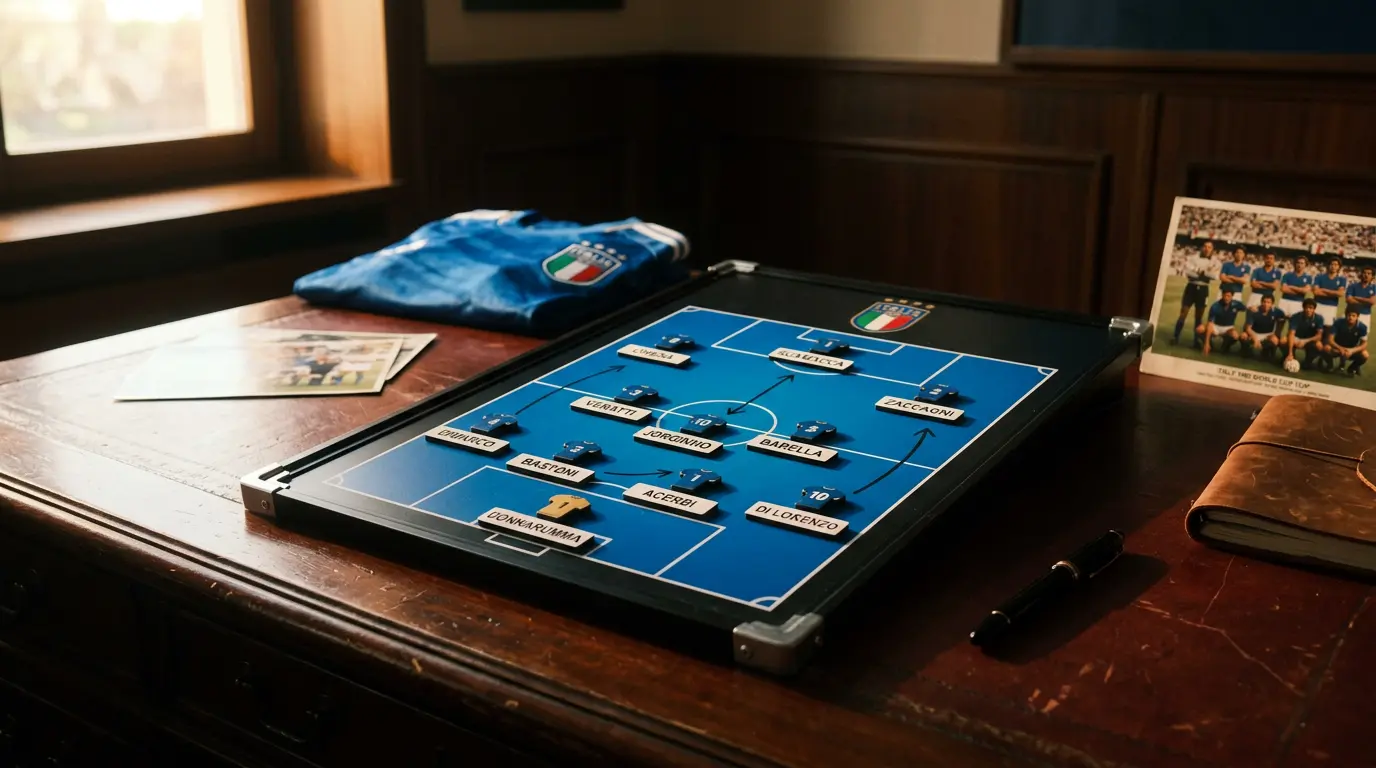
The Azzurri need a coach. That sentence, stark and embarrassing for a nation of Italy’s footballing stature, has been true for too long – and now the name being whispered with the most reverence is also the most improbable: Pep Guardiola.
With the Manchester City manager expected to depart the Etihad Stadium at the end of the season after a decade at the club, Italian football is doing what it has always done in a crisis: reaching for the grandest possible dream.
Three domestic candidates – Antonio Conte, Massimiliano Allegri, and Claudio Ranieri – have emerged as the serious alternatives in Italian media.
But it is the Guardiola thread, however fragile, that has captured the imagination of a fanbase desperate for transformation rather than consolidation.
The Guardiola Question: Why This Link Has Traction
The logic, on paper, is not entirely fantasy. Guardiola is leaving Manchester City.
He has spoken openly – telling Televisión Española in 2022 that coaching at a World Cup or Euros “would be a beautiful experience” – of his desire to manage a national team one day.
His connections to Italy are genuine: he played as a midfielder for both Roma and Brescia, and La Gazzetta dello Sport has been the most vocal advocate for the appointment, citing those formative Italian ties as the cultural foundation for a credible candidacy.
Azzurri legend Leonardo Bonucci, who served as Gennaro Gattuso’s assistant until March, gave the idea its most prominent recent endorsement.
“I think it’s very hard, but dreaming doesn’t cost anything,” Bonucci said. It is an honest assessment – and the word ‘hard’ is doing considerable heavy lifting.
The financial reality is damning. Guardiola earned an estimated €20 million per year at City – a figure that dwarfs anything the FIGC has ever offered a Nazionale coach, with Luciano Spalletti reportedly on approximately €3 million net.
Any approach would require commercial partners to underwrite a deal of unprecedented scale for Italian football.
That is before accounting for the possibility, reported by Goal.com, that Guardiola may opt for a sabbatical entirely.
The dream, as Bonucci acknowledged, costs nothing – but delivering it would cost an enormous amount.
The Azzurri Vacancy: A Crisis Too Long in the Making
The context behind Italy’s managerial search is one of historic and repeated failure – three World Cup absences in a row, a group-stage Euro exit, and a managerial carousel that has produced neither stability nor results.
Gattuso’s tenure ended without the qualification it demanded, and the federation now finds itself in institutional paralysis.
Italy will not hire a new coach before June 22, 2026 – the date of the FIGC presidential election.
Outgoing president Gabriele Gravina is handling only administrative duties, and no contact has yet been made with any candidate.
The role itself remains enormous: a full structural rebuild of Italian football’s relationship with its national team, not merely the appointment of a tactician to oversee qualifying matches.
The Three Candidates: Who Is Actually in the Frame
Antonio Conte is the name that generates the most heat. Expected to depart Napoli after two seasons – as he has departed every club before him – Conte has publicly made himself available for a second stint as Nazionale coach.
His record of immediate impact is beyond question; his record of longevity is not.
As the complexities around his Napoli situation illustrate, separating Conte from any club is rarely straightforward, and the FIGC would need a president willing to match his demands in full.
Massimiliano Allegri presents a different set of complications.
He has one year remaining on his Milan contract – extended to 2028 if the Rossoneri qualify for the Champions League – but his relationship with Senior Advisor Zlatan Ibrahimovic and CEO Giorgio Furlani has reportedly deteriorated.
An exit from San Siro would free him, but Allegri as Italy coach invites the same debate that has followed him throughout his career: is defensive pragmatism sufficient for a nation that has already tried pragmatism and found it wanting?
Claudio Ranieri turned down the Italy job once already, citing his commitment to Roma at the time.
He is now free – and he said so plainly on Sky Sport Italia earlier this month. “At this point in time, I am free, so if anyone was to call, why not? Never say never,” Ranieri stated.
At 74, his candidacy is best understood as an interim stabilisation option rather than a long-term architectural project – which may be precisely what an embattled FIGC reaches for in the absence of a transformative choice.
What the Search Reveals About Italian Football
The fact that the most credible candidates are a coach who never stays anywhere long, a coach whose last cycle ended in mediocrity, and a septuagenarian stopgap – with the wider public loudest about a Spaniard who may be taking a year off – says something damning about Italian football’s structural condition.
The calcio establishment is not short of ambition; it is short of the institutional coherence to convert ambition into appointments.
Guardiola’s name generates excitement precisely because the realistic alternatives generate so little.
That is not entirely fair to Conte, Allegri, or Ranieri – each has genuine credentials – but it reflects a truth about where the Nazionale stands.
Even Cesc Fàbregas, previously linked with the Italy role, represented a more forward-looking impulse than the names currently dominating the conversation.
Until June 22, none of it will move. A new FIGC president must first be elected, a budget agreed, and a genuine sporting vision – not merely a managerial name – committed to paper.
Italian football has long been expert at identifying what it needs. Whether it possesses the will to actually build it remains, as ever, the only question that matters.