Enzo Maresca is set to inherit one of the most demanding jobs in world football – replacing Pep Guardiola as Manchester City head coach at the end of the 2026-27 season.
That succession story is not simply one of institutional convenience. It is the culmination of a coaching education that began, in Maresca’s own telling, the moment he first faced Guardiola’s Barcelona from the other side of the pitch.
For followers of Italian football, this matters beyond the Premier League. Maresca is an Italian coach – formed in Coverciano, shaped by Serie A’s tactical tradition – who has absorbed the defining tactical philosophy of his generation at its very source.
What he does with that education will say something significant about where Italian coaching is headed.
The Guardiola School: What Maresca Learned at Manchester City
Guardiola‘s influence on Maresca did not begin in a coaching manual or a conference room.
It began on the pitch, when Maresca was a midfielder at Sevilla and found himself on the wrong end of a Barcelona masterclass.
“Playing against that Barcelona team with Sevilla made me realise I wanted to become a coach,” Maresca said at the Festival dello Sport in Trento in October. The experience was not demoralising – it was revelatory.
When Maresca eventually joined City’s coaching staff, first as head of the Elite Development Squad from 2020 to 2021, and again as Guardiola’s assistant from 2022, the theoretical fascination became a working education.
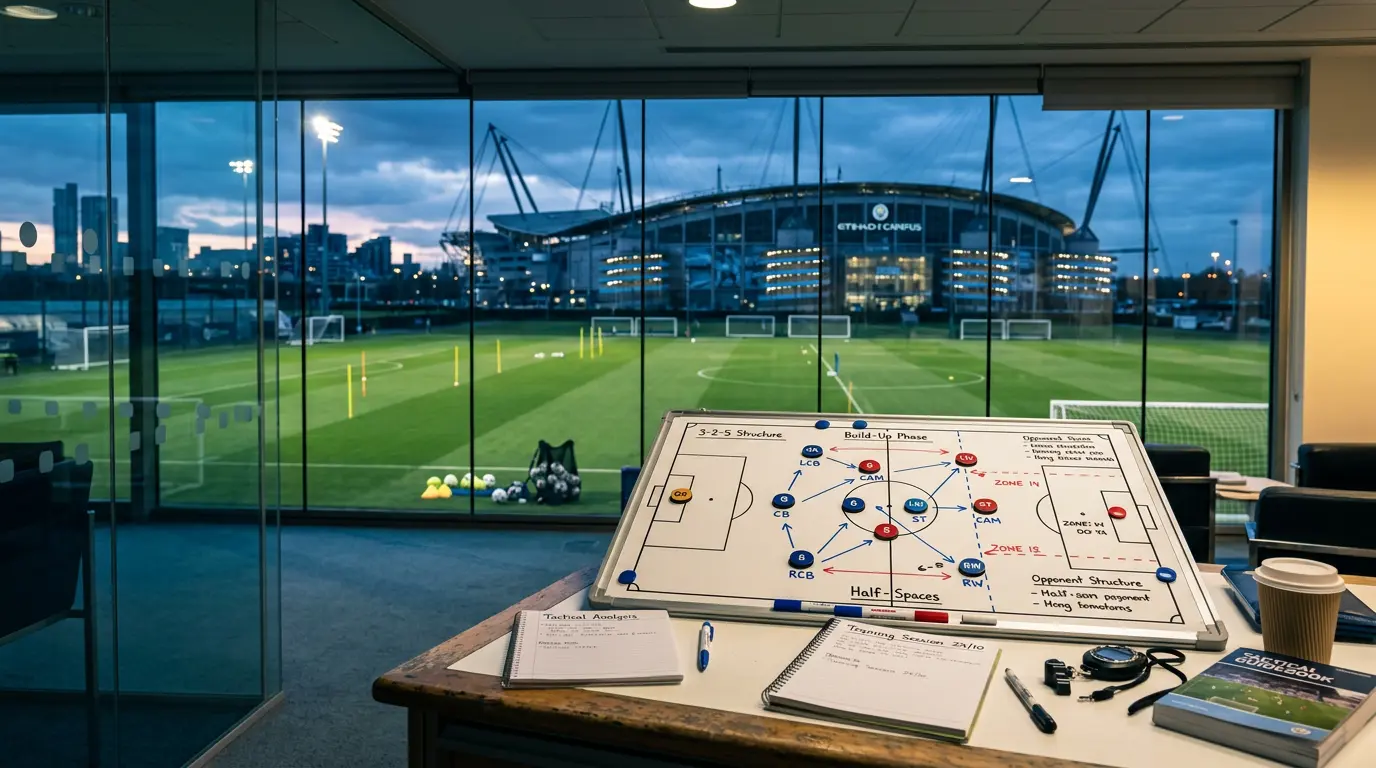
He was inside the machine that produces Juego de Posición at the highest level – observing how Guardiola structures attacking phases through positional superiority, how the 3-2-5 build-up shape creates numerical advantages in central zones, and how inverted full-backs redefine the width of a midfield.
“Being close to someone like Pep was fantastic, seeing how he looks at details and how he manages the team – that was fundamental for my growth,” Maresca has said.
That attention to detail is not incidental to Guardiola’s success. It is the system. And Maresca, by his own account, was paying close attention.
From City’s Training Ground to the Dugout: The Maresca Method
The transmission of Guardiola’s ideas into Maresca’s own coaching output has been traceable at every stop.
During his single season leading Manchester City’s Elite Development Squad, Maresca guided the U23s to the 2020-21 Premier League 2 title – finishing 14 points clear, averaging over three goals per game, and deploying the same 4-3-3 and 3-2-5 structures Guardiola was running upstairs. The fingerprints were unmistakable.
At Leicester City in 2023-24, the proof of concept became undeniable.
Maresca delivered automatic promotion from the Championship with 97 points, 89 goals, and an average possession figure above 60% – widely cited as the clearest club-level reproduction of Guardiola-style positional play in English football outside the Etihad.
Analysts at The Athletic described Maresca as “the most Guardiola-like coach of his generation,” pointing specifically to his automatisms in build-up and his insistence on ‘rest defence’ structures when out of possession.
Guardiola remains Maresca’s explicit frame of reference. “I’ve been lucky to have a lot of great coaches, from Ancelotti to Lippi, but the style of football that has always fascinated me has been Guardiola’s,” he said in Trento.
That is not an empty tribute – it is a coaching manifesto.
An Italian Coach Shaped by the Best in the World
There is a broader context here that the Italian football world should not overlook.
Maresca’s trajectory – from Coverciano’s UEFA Pro Licence programme, where his thesis examined positional play and build-up structures, to the inner circle of the most successful coaching operation in modern European football – represents something genuinely new for the Italian school.
Italy has always exported coaches. From Ancelotti to Lippi, from Capello to Conte, the Azzurri coaching tradition has carried weight globally.
But the modern generation faces a different challenge: absorbing the Guardiola revolution without abandoning Italian football’s structural intelligence. Maresca may be the figure who best bridges that gap.
Cesc Fàbregas at Como offers a parallel narrative – another elite football mind applying possession-based doctrine at club level – but Maresca’s Italian identity makes his case distinctly pointed for the national conversation.
Guardiola won six Premier League titles, the 2022-23 Champions League, and a historic treble in the season Maresca served as his assistant. That is the legacy being handed on.
Whether Maresca can translate it into City’s next chapter – and what it signals for Italian coaching’s place at the summit of the game – is the story worth watching now.